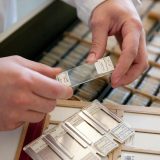
Type Definition
A type specimen is a specimen selected to serve as a reference point
when a plant species is first named. As a result, these specimens are extremely
important to botanists who are attempting to determine the correct application
of a name. They are often specially curated in herbaria, such as at the NYBG,
where they are filed separately. There are several different categories of types;
the most common are:
Holotype: The single specimen designated as the type of a species
by the original author at the time the species name and description was
published.
Isotype: A duplicate specimen of the holotype.
Syntype: Any of two or more specimens listed in the original description
of a taxon when a holotype was not designated.
Isosyntype: A duplicate of a syntype.
Paratype: A specimen not formally designated as a type but cited along
with the type collection in the original description of a taxon.
Lectotype: A specimen chosen by a later researcher to serve as if it
were the holotype. It is chosen from among the specimens available to the original
publishing author (the isotypes, syntypes and/or paratypes) of a scientific
name when the holotype was either lost or destroyed, or when no holotype was
designated.
Neotype: A specimen chosen by a later researcher to serve in place of
a holotype when all specimens available to the original publishing author of
a scientific name have been lost or destroyed.
Topotype: A specimen of a plant collected from the same locality as
the holotype and usually on a different date. A topotype has no formal standing.
= locotype
Cotype: A term formerly used for syntype and sometimes (erroneously)
for isotype and paratype. This is an old term that was used loosely and is not
used by today's taxonomists.
Generitype: The type specimen of a genus. It is designated by using
the type for the name of a particular species within that genus. For example,
the generitype for Aster is the type for Aster amellus L.
For further information on the Vascular Plant Type Specimens Imaging
Project, please contact our Imaging Coordinator.
Back to Top
|