The
Fungal Collections of George Washington Carver
at NYBG
George Washington Carver was an
extraordinary scientist and role model. To this day, his name is
synonomous with black ability and achievement. He represents a
man who has contributed greatly to science throughout his
lifetime. Carver was born of slave parents on a farm near Diamond
Grove, Missouri, around 1864. His boyhood, which was full of
struggle against poverty and illness, ended when he entered Simpson
College in Iowa, and from there he went on to Iowa State
University. After
graduation, he received the appointment of Assistant Botanist at the
Experiment Station. In 1896 he became Head of the Agricultural
and Dairy Department at the Tuskegee Institute in Tuskegee,
Alabama. Very soon after his arrival in Tuskegee in 1896, Carver
cooperated with Franklin
Sumner Earle, the Chair of Biology and
Horticulture in the Alabama Polytechnic Institute at Auburn, Alabama,
in compiling a preliminary list of the fungi of Alabama which was later
published. This study formed the basis of a relationship that lasted
the entire time that Earle was at Auburn. In 1901, F. S. Earle came to
The New York Botanical Garden, serving as the Garden's first
mycologist.
Throughout his career,
Carver
developed hundreds of products from peanuts, sweet potatoes, and clays;
promoted home-canning and the addition of natural fertilizers to
improve soil fertility; studied insect and fungal diseases; and
developed new varieties of cotton and Amaryllis. Of the many
contributions G. W. Carver made to science, one that has been
under-emphasized is his role as a fungal collector. Throughout his
career, Carver maintained a steady interest in mycology. While at Iowa
State, he developed a talent for collecting fungal specimens. Since
mycology was a scientific discipline that required a high degree of
training and sophisticated equipment for proper identification, and
Carver had neither training nor equipment, he often sought the aid of
trained mycologists. While his preliminary identifications were
remarkably accurate, Carver's real gift was for finding rare and new
species. Throughout his career, he sent specimens to numerous
mycologists and plant pathologists.
Job
Bicknell Ellis, a
prominent mycologist whose herbarium was purchased by NYBG, received
many valuable specimens in return for aiding Carver in identification.
It is suspected that Carver's collections ended up at NYBG because of
his relationship with J. B. Ellis. In 1902, Ellis collaborated with
Benjamin Matlack Everhart on an article entitled 'New Alabama Fungi'
which listed 60 important species he had received from Carver.
Included in the list were two new species that Ellis and Everhart had
named for the Tuskegee scientist.
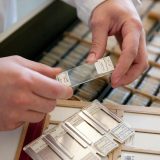
The fungus herbarium
at
The New York Botanical Garden has more than 100 specimens collected by
Carver. Most of these specimens are represented in the exsiccati 'Fungi
Columbiani' by Ellis & Everhart. It is suspected that many
more of Carver's collections exist in the herbarium. These specimens
will be available in an on-line searchable catalogue in the near
future.
Photograph of G.
W. Carver courtesy of Iowa State University Archives
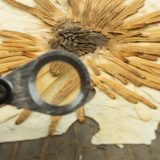
Fungal specimen
image by Gord Lemon |