|
 |
A transverse, stained section of Cycas rumphii stem shows lignified cells and girdling leaf traces
|
 |
|
|
 |
Structural Botany Labs
Research conducted in the Structural Botany is aimed at understanding the diversity and evolution of plants and fungi. Comparative and ontogenetic approaches provide insight into character evolution that results in the biodiversity we see. Morphological and anatomical data complement our specimen-based research, and are often combined with molecular data obtained in the Cullman Program for Molecular Systematics and Genomics Program for phylogenetic analysis.
The Structural Botany laboratories are used by New York Botanical Garden scientists, graduate students, and has provided training and research opportunities to high school students, undergraduate interns, graduate students, postdoctoral researchers, visiting scientists, and volunteers. Research conducted in the Structural Botany Labs interfaces with the Garden's efforts to conserve plant and fungal biodiversity and to understand the effects of climate change on our environment.
Facilities
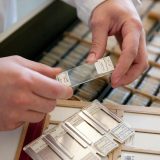
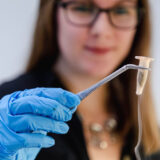
The Structural Botany laboratories have a full suite of standard equipment used for plant microtechnique, and some automated equipment for high-throughput tissue processing. Microscope facilities are equipped with imaging and computing tools. The light microscopy facility includes equipment for observing and documenting plant anatomy and histochemistry with fluorescence or differential interference contrast. The scanning electron microscope (SEM) has a high-resolution SEM with low- and high-vacuum capabilities.
|
|
|
|
 |
|
|
 |
 |
 |
Associated Researchers |
 |
 |
 |
Lisa M. Campbell
Dennis W. Stevenson
Flor Henderson Hostos Commuinty College, City University of New York
Cameron McNeil Queens College, City University of New York
Guy Robinson Fordham University
Judith Garrison Hanks Marymount College
|
 |
|
|